Steps to Calories: Why Every Estimate Is Different
Steps alone do not determine calories. See how distance, body weight, pace, time, and MET values shape a transparent walking estimate.

In this guide · 6 sections
There is no universal calories-per-step number. A step count does not reveal how far each step traveled, how long the movement took, the pace or grade, body mass, or how an individual body used energy.
A useful calculator has to build the estimate in stages: steps become distance through step length; distance becomes time through pace; time, body weight, and an activity intensity value become estimated energy.
This guide opens that model, explains active versus total calories, and shows why a phone, watch, treadmill, and web calculator can produce different answers without one simple number proving the others are broken.
The short answer
Steps alone cannot determine calories. A transparent estimate needs step length, body weight, walking pace, and time; even then it remains a population-based model rather than a direct measurement of your metabolism.
What to remember
- Calories per step is not constant across people or conditions.
- The calculator first estimates distance and duration.
- MET values are standardized research tools, not personal measurements.
- Active calories and total calories answer different questions.
Why steps do not convert directly to calories
Two people can record 8,000 steps and travel different distances because their step lengths differ. They can cover those distances at different speeds, on different grades, and with different body masses. A single calories-per-step multiplier erases every one of those variables.
Even the same person can change the relationship across days. A slow indoor day, a brisk level walk, a hilly route, and repeated stair climbs may produce similar step counts with different energy demands. Carrying a load, pushing a stroller, surface, weather, and fatigue can add more variation.
That does not make estimation pointless. It changes the standard of honesty: state the inputs, use a model suited to the activity, round the result, and avoid describing it as measured unless energy expenditure was actually measured with an appropriate method.
Keep in mind
This calculator models level walking. It does not add separate adjustments for hills, stairs, loads, wind, temperature, or assistive devices.
Build the estimate in four stages
Stage one converts steps to distance: steps × step length in inches ÷ 63,360. Stage two estimates moving time: distance in miles ÷ miles per hour. Stage three converts body weight to kilograms when needed. Stage four applies a walking MET value to the estimated time and body mass.
The 2024 Adult Compendium of Physical Activities lists standardized MET values for specific walking speeds and conditions. The GhostLoop calculator uses four level, firm-surface pace bands: 2.8 METs for an easy 2.2 mph selection, 3.8 at a steady 3.0 mph, 4.8 at a brisk 3.7 mph, and 5.5 at a fast 4.2 mph.
Those labels are interface shorthand. The published Compendium entries describe speed ranges, and a real walk may move between them. Choose the band that best represents the purposeful walking being estimated rather than automatically selecting the highest intensity.
Walking pace bands used by the calculator
Swipe table →| Calculator selection | Speed | MET value |
|---|---|---|
| Easy | 2.2 mph | 2.8 |
| Steady | 3.0 mph | 3.8 |
| Brisk | 3.7 mph | 4.8 |
| Fast | 4.2 mph | 5.5 |
Count → distance → time → energy.
7,500
3.31 MI
66 MIN
≈225 KCAL
Separate active calories from total calories
The standard shortcut for total energy is MET × body weight in kilograms × activity time in hours. It includes the resting energy represented by one MET during the same time. Some devices label a number closer to exercise-only energy as active calories.
To create the calculator’s active estimate, subtract the one-MET resting component before multiplying: active kcal = (MET − 1) × kilograms × hours. The total and active numbers are not two competing measurements. They answer different accounting questions.
Even this distinction is approximate. The standard one-MET convention is based on 3.5 milliliters of oxygen per kilogram per minute, or roughly one kilocalorie per kilogram per hour. Research has shown that this convention can overestimate resting metabolism for many individuals. The Compendium itself provides corrected-MET context for that limitation.
Follow one complete worked example
Suppose a 160-pound person enters 7,500 steps, a 28-inch step length, and a steady 3.0 mph pace. First, 7,500 × 28 ÷ 63,360 estimates 3.31 miles. At 3.0 mph, that distance takes about 1.10 hours, or 66 minutes.
One hundred sixty pounds is about 72.6 kilograms. The steady pace uses 3.8 METs. Total energy is 3.8 × 72.6 × 1.10, or about 305 kilocalories. Active energy uses 2.8 instead of 3.8, producing about 225 kilocalories.
The rounded answer is more honest than a decimal-rich result. Step length, speed, MET selection, body weight, and the standard MET convention all contain uncertainty before the calculator performs perfectly exact arithmetic on them.
Total includes rest. Active removes it.
Understand why your wearable is different
A wearable may use heart rate, age, height, sex, fitness history, GPS, speed, elevation, temperature, and proprietary calibration. Some report active calories prominently and place total energy elsewhere. A treadmill may use speed, grade, time, and entered weight without seeing how efficiently an individual moves.
The GhostLoop calculator intentionally uses fewer inputs because each one can be shown. That transparency is an advantage for understanding the model, but it is not a claim that the result is more individually accurate than a device with additional valid signals.
Compare like with like. Use active against active or total against total, keep the same body-weight and pace settings, and compare similar level walks. A sudden difference may be a permissions, sensor, heart-rate, GPS, or data-source issue; a small recurring difference may simply reflect different models.
- Check whether the device reports active or total calories.
- Confirm that body weight and units are current.
- Compare the same activity window, not a workout with an entire day.
- Treat large repeated changes as something to inspect, not immediate proof of a metabolic change.
Sources [5]
Use calorie estimates without asking too much of them
A modeled calorie number can help compare similar walks, explain why pace changes the result, or provide one piece of activity context. It is less suited to precise food compensation, rapid weight-change promises, or judging whether one day was good enough.
The CDC notes that calorie use varies with body weight and activity intensity. Individual energy balance is broader than one walk and includes intake, resting metabolism, daily movement, and many personal factors. A web calculator cannot turn that system into an individualized prescription.
If weight, nutrition, metabolic health, pregnancy, medication, an eating disorder, or another health concern makes calorie tracking risky or medically important, use guidance from a qualified professional who knows the situation. It is always acceptable to use steps, time, route, or how the activity felt instead of calories.
Keep in mind
The calculator is general educational information. It does not diagnose metabolism, measure energy expenditure, or provide a food or weight-loss target.
Sources [5]
Fast answers
Frequently asked questions
How many calories are 10,000 steps?
There is no fixed answer. The estimate depends on step length, body weight, walking speed, time, terrain, and individual physiology. Enter those variables rather than multiplying by one universal calories-per-step rate.
What does MET mean?
MET means metabolic equivalent of task. It expresses an activity’s energy rate relative to a standard resting convention. A 3.8-MET activity uses a standardized rate 3.8 times that convention, not a personal metabolic measurement.
Are active calories better than total calories?
They answer different questions. Total includes the modeled resting energy during the activity; active removes a one-MET resting component. Use the version that matches what you are comparing.
Does walking faster always burn more calories for the same steps?
Not in a simple linear way. Faster walking raises the MET rate but may also change step length and reduces the time needed to cover a given distance. The calculator includes both pace intensity and estimated duration.
Can a step calculator measure my metabolism?
No. It applies published population-level values to the inputs you provide. Direct metabolic measurement requires specialized methods and still depends on the question and testing conditions.
Bottom line
Make the next decision repeatable.
A calorie estimate is most useful when its assumptions remain attached. Use the number to compare similar walks under similar settings, not to claim laboratory precision, compensate for food, or judge a body. The honest output is a model you understand well enough to question.
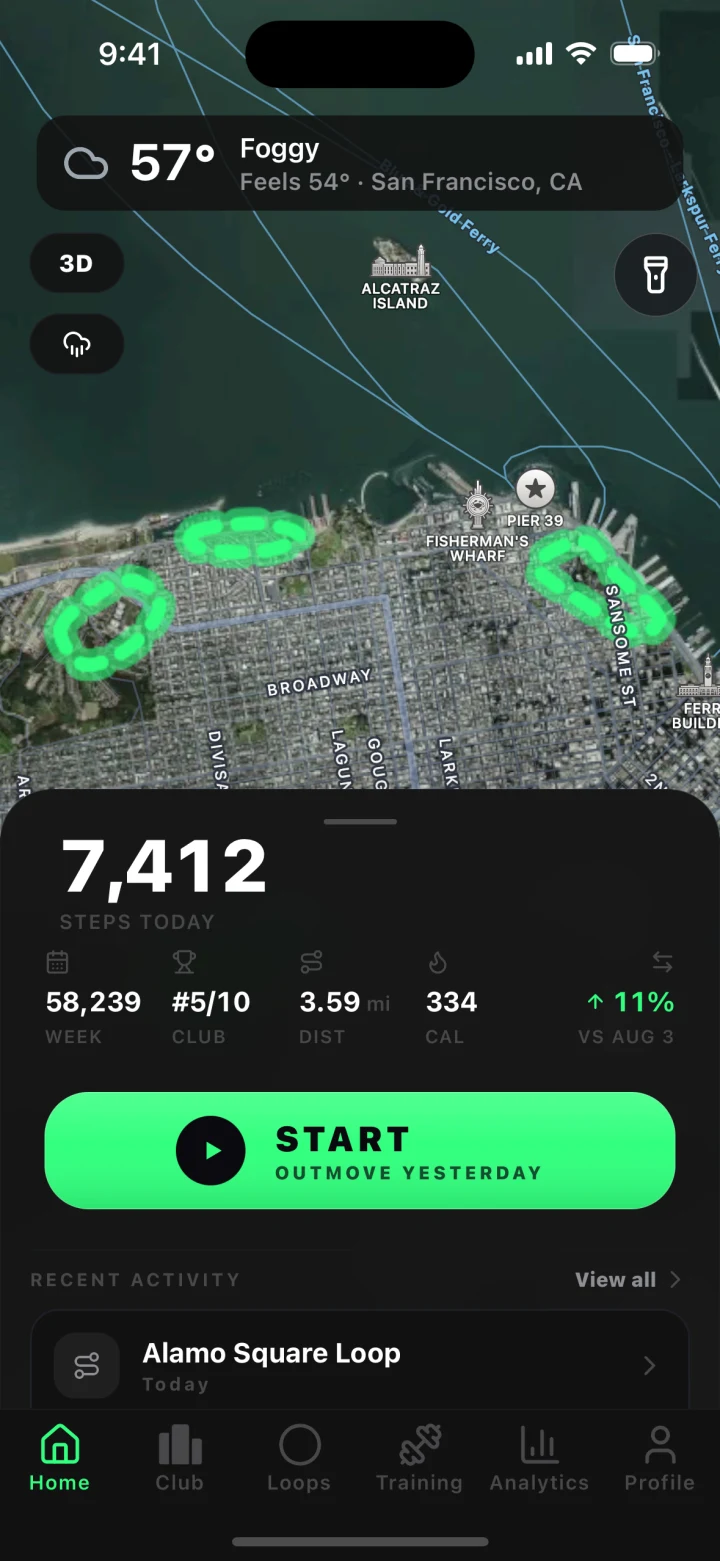
The calorie number is one signal.
The real Home screen shows calories next to steps and distance rather than turning one estimate into the entire story of the activity.
Captured from GhostLoop iOS · August 2026Put it in motion
Adjust steps, weight, step length, and pace. GhostLoop shows active and total estimates with the full model beside them.
Estimate walking caloriesEditorial note
How this guide was made
The article and calculator use the 2024 Adult Compendium pace entries and its published MET unit conversion. Active calories are explicitly derived by removing one MET from the total-rate formula. Worked examples were calculated from unrounded intermediate values, then rounded for display. Limitations are informed by the Compendium, CDC, and cited MET research; this is not individualized medical or nutrition advice.
Sources & further reading
About the author
Ian Castillo · Founder, GhostLoop
Ian Castillo is the founder of GhostLoop, a movement app built around racing your past activity, Ghost Pacers, Clubs, and Challenges.
Author profileThis guide is general educational information, not individualized medical advice. Stop activity and seek appropriate professional guidance if symptoms or pain concern you.