How Many Steps a Day Should You Walk in 2026?
A practical way to choose a daily step goal based on your current average—not somebody else’s round number.

In this guide · 5 sections
Ten thousand steps is memorable, but it is not a universal pass-or-fail line. The most useful daily step goal starts with what you do now and gives you a clear, repeatable next move.
This guide separates the research signal from the round-number mythology, then shows you how to measure a normal week, choose a first increase, and turn that increase into specific moments in your day.
The goal is not to find the highest number you can touch once. It is to find a useful target you can understand, adjust, and return to after an imperfect day.
The short answer
Use a normal seven-day average as your baseline, add a modest amount you can repeat, and review after two weeks. For many people, progress begins well below 10,000 steps.
What to remember
- There is no single required step count for every adult.
- More movement can matter even when the total stays below 10,000.
- A personal baseline is more actionable than a borrowed target.
- Increase the goal only after the current one feels repeatable.
Where did 10,000 steps come from?
Ten thousand became a durable target because it is easy to remember and easy to display. It is not a biological switch. Your body does not wait for step 10,000 before movement matters, and a day at 9,800 is not meaningfully transformed by another 200 steps.
Modern step-count research is better read as a dose-response curve than a cutoff. A 2025 systematic review found that higher daily step counts were associated with better outcomes across several measures, while many curves began to flatten around roughly 5,000 to 7,000 steps. Flattening does not mean additional movement is useless; it means the size of the observed gain may change as totals rise.
That distinction matters for planning. If your normal day is 3,200 steps, moving toward 4,000 is a real intervention in your routine. A target does not need five digits to be worth pursuing.
Keep in mind
Association is not the same as a guarantee. Age, health, ability, and how steps are measured all affect interpretation.
Sources [1]
Find your real baseline
Use seven complete, ordinary days—not vacation, race week, or the week you were sick. Add the daily totals and divide by seven. Keep weekdays and weekends in the sample because the contrast between them often explains more than the average alone.
Also calculate the median: put all seven totals in order and choose the middle one. The average can be pulled upward by one unusually active Saturday; the median shows what the center of the week looked like. If the two numbers are far apart, your first problem may be consistency rather than capacity.
Treat missing device data as missing, not as a zero. Collect another complete week if your watch was uncharged or your phone sat on a desk for most of a day. Use the same device and carry pattern throughout the baseline period because consumer devices can count the same free-living movement differently.
- Record all seven daily totals.
- Mark the average, median, lowest day, and highest day.
- Write one sentence about what made the low day difficult.
- Do not deliberately add activity while establishing the baseline.
Sources [3]
Baseline + a repeatable step
Choose the first increase
A useful first increase is large enough to change one decision and small enough to survive your least convenient weekday. For many people, 500 to 1,000 steps is a practical experiment. That is an editorial starting range, not a medical prescription.
You can also plan with time: add a five-to-ten-minute walk and observe what your own device records. Step-per-minute conversions vary with stride, pace, terrain, mobility, and where the device is worn, so your personal observation is more useful than a universal calculator.
Hold the new target for two weeks. If you meet it on most normal days without repeatedly borrowing from sleep or aggravating pain, you can consider another increase. If you need a late-night rescue walk every evening, adjust the plan before blaming your discipline.
Editorial starting points
Swipe table →| Current pattern | First experiment | What to watch |
|---|---|---|
| Below 3,000/day | Add about 500 | Can one short cue make the difference? |
| 3,000–7,000/day | Add 500–1,000 | Does the target fit weekdays and weekends? |
| Above 7,000/day | Improve consistency first | Can you reduce the gap between high and low days? |
Turn the number into a day
A number by itself does not tell you what to do at 11:40 a.m. Give the goal locations and times. Split the extra movement across moments you already control instead of leaving the entire deficit for the evening.
For a 1,000-step increase, you might test a brief loop after coffee and another after lunch. On a meeting-heavy day, the first loop protects part of the goal before the schedule tightens. On a good day, the evening walk becomes optional rather than an emergency.
Build a primary cue
Choose the moment most likely to occur: after coffee, after arriving at work, after lunch, or after dinner. Write the cue as an action: ‘After I put away my lunch, I walk one loop.’
Keep a short fallback
Define the smallest version in advance. Five minutes, one block, or one trip around the building keeps the cue intact when the original plan no longer fits.
Stop rescuing every day
An occasional evening catch-up can be fun. A nightly deficit is feedback that the target or timing needs work. Move part of the walk earlier, shrink the increment, or create different weekday and weekend expectations.
Raise it, hold it, or reshape it.
Most days
Recovery feels normal
Raise 500–1,000
Some days
The routine is uneven
Hold for 2 weeks
Rarely
Rescue walks repeat
Lower or relocate
Review the goal without judging the week
After 14 days, sort the outcome into three decisions: raise, hold, or reduce. Raise only when the routine is stable—not because one long hike inflated the average. Hold when the goal is challenging but workable. Reduce when it repeatedly conflicts with recovery, pain, sleep, or the realities of your schedule.
Look for the reason behind missed days. A target missed because the device stayed home is a measurement problem. A target missed because the only planned walk depended on perfect weather is a route problem. A target missed because it requires more activity than is currently comfortable may be a progression problem.
Lowering a goal during illness, travel, major schedule changes, or a return from inactivity is not erasing progress. It is keeping the target connected to the conditions in which it must operate.
- Raise: reached on most normal days and recovery feels ordinary.
- Hold: close enough to remain useful, but not yet automatic.
- Reduce: repeatedly requires compensation or creates concerning symptoms.
- Rebuild: device data or schedule changed enough that the old baseline no longer represents you.
Keep in mind
If you have a health condition, are recovering from injury, or have concerns about safe activity, use guidance from a qualified clinician who knows your situation.
Sources [2]
Fast answers
Frequently asked questions
Do I need 10,000 steps every day?
No single daily step count is required for every adult. Research supports the value of moving more from a lower baseline, but the useful target depends on your health, ability, routine, and current activity. Treat 10,000 as an optional goal, not a universal verdict.
Should my step goal change with age?
Age can affect recovery, health context, and what is practical, but age alone cannot produce one correct number. Start with your own baseline and use professional guidance when a condition, symptom, disability, or recovery changes what is safe.
How many miles is 10,000 steps?
There is no exact conversion because stride length changes by person, pace, and terrain. If distance matters, record a known route with your usual device and use that personal relationship rather than assuming a universal miles-per-step value.
What should I do after a missed day?
Resume the normal plan. Do not automatically double the next day or turn a weekly total into punishment. If the same barrier keeps causing misses, change the cue, route, or goal rather than relying on catch-up walks.
Why does my phone show a different count than my watch?
Devices use different sensors, algorithms, wear positions, and rules for recognizing movement. Keep one primary device for comparisons, wear or carry it consistently, and treat its count as an estimate rather than laboratory truth.
Bottom line
Make the next decision repeatable.
A useful step goal is not the largest number you can reach once. It is the next number that helps you make a better decision on an ordinary day, then leaves enough room to return tomorrow.
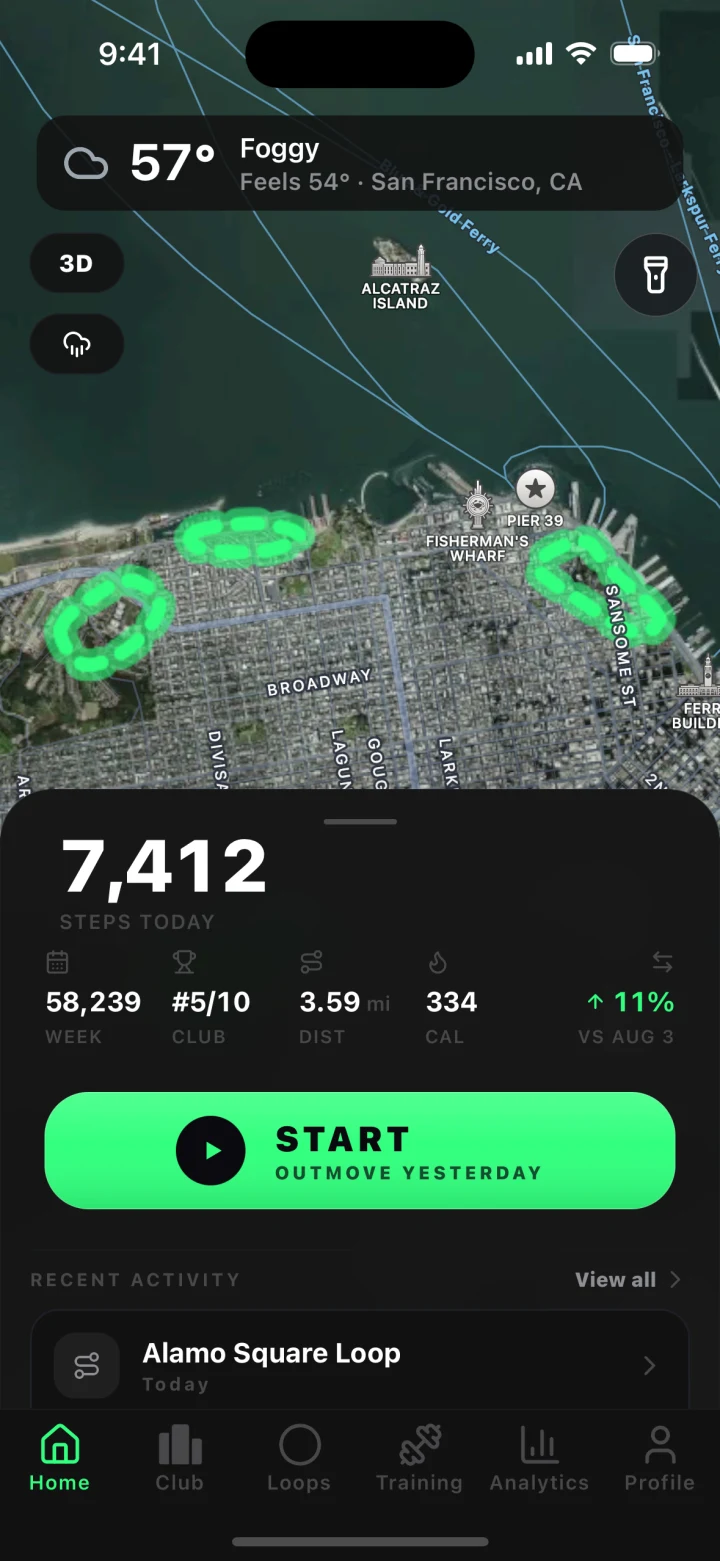
Today’s steps stay in context.
The real GhostLoop Home screen keeps today’s steps next to weekly volume, Club rank, distance, and your comparison with a prior day.
Captured from GhostLoop iOS · August 2026Put it in motion
GhostLoop scales the fastest Ghost Pacer to the goal you choose, so your race starts from your number—not somebody else’s.
Meet the Ghost PacersEditorial note
How this guide was made
Research statements in this guide are tied to the public sources below. The baseline worksheet, starting ranges, and 14-day review are GhostLoop editorial planning tools, not clinical prescriptions. This guide was reviewed against the current GhostLoop goal-scaling behavior and does not claim medical review or individualized outcomes.
Sources & further reading
About the author
Ian Castillo · Founder, GhostLoop
Ian Castillo is the founder of GhostLoop, a movement app built around racing your past activity, Ghost Pacers, Clubs, and Challenges.
Author profileThis guide is general educational information, not individualized medical advice. Stop activity and seek appropriate professional guidance if symptoms or pain concern you.