How to Choose a Ghost Pacer for Your Step Goal
Nine scaled rungs, five daily walks, and one honest LIVE state. Choose the pacer whose gap gives you a useful next move.

In this guide · 7 sections
A Ghost Pacer turns your daily goal into a field instead of a pass-or-fail line. Nine characters occupy nine rungs, from a gentle nudge to the top pacer anchored to the goal you set.
The choice is primarily about pace and the size of the gap you want to chase. The ghosts share a five-walk day structure, while each pacer’s exact session times and good-day or off-day factor vary deterministically by pacer and local date.
This guide explains the actual shipped model—including where the numbers move, what LIVE means, and why two people see the same pacer behavior at the same moment.
The short answer
Set your real goal, find the pacer one rung above your normal day, and try that chase for three to seven ordinary days. Choose by pace and motivation—not by a fictional fixed morning or evening personality.
What to remember
- Your selected goal controls the top rung.
- The entire nine-pacer ladder scales proportionally.
- LIVE appears only during one of five active walks.
- Schedules and daily variation are deterministic and shared.
Start with your real goal
Set the step target you are actually trying to repeat. GhostLoop takes the original nine-pacer ladder and rescales every rung by the same factor. Kick—the top rung—lands exactly on your chosen base goal. Everyone below Kick remains the same share of that top pace.
At a 10,000-step goal, Kick’s usual pace is 10,000 and Glow’s is 9,032. At a 6,000-step goal, those usual paces become 6,000 and 5,419. The order and spacing remain intact, so a lower goal does not collapse the cast into arbitrary numbers.
This makes the field usable at different baselines. Someone with a 6,000-step target should not have to chase a fixed 12,400-step top ghost simply because that was the original calibration.
The nine pacers at a 10,000-step goal
Swipe table →| Pacer | Usual steps | Share of top | Character |
|---|---|---|---|
| Hollow | 3,468 | 34.7% | A nudge, not a race |
| Loo | 4,194 | 41.9% | Small. Undeterred. |
| Loaf | 4,677 | 46.8% | Unhurried. Never stops. |
| Drift | 5,323 | 53.2% | Always just ahead |
| Shadow | 5,968 | 59.7% | Matches most days |
| Wisp | 6,935 | 69.4% | Never sits still |
| Casper | 7,903 | 79.0% | Friendly. Relentless. |
| Glow | 9,032 | 90.3% | You will feel this one |
| Kick | 10,000 | 100% | Bring your legs |
Keep in mind
The table shows each pacer’s scaled usual pace. A deterministic daily factor can put that day’s final simulation slightly below or above usual; that behavior is explained later in the guide.
Choose the next rung, not the final boss
Compare your recent normal day with the scaled ladder. The most useful first pacer is usually the first one above that number—not automatically Kick. A close gap can prompt one more walk; an enormous gap often becomes decoration.
If your seven-day average is 5,500 with a 10,000-step goal, Shadow at 5,968 is the nearest clear stretch and Wisp at 6,935 is a more demanding chase. Glow and Kick can remain visible as future rungs without becoming today’s assignment.
Personality can break a tie. The characters are intentionally distinct so the leaderboard remains legible and the chase feels like someone, not a gray benchmark. Personality changes the feel of the choice; the scaled step number defines its difficulty.
Nine rhythms. One goal.
Understand the five-walk day
Pacers do not gain steps as a constant 24-hour trickle. Each day has five walking bursts: morning, lunch, afternoon, a longer evening session, and a final turn after dark. Steps accumulate only while a session is active and hold still between sessions.
The times below are the schedule anchors. The actual start and duration are shifted for each pacer and local date, then kept in chronological order. That means a pacer does not permanently own an ‘early’ or ‘late’ identity, and today’s exact times should not be treated as a promise for tomorrow.
Daily session structure
Swipe table →| Anchor | Session | Share of daily output | What changes |
|---|---|---|---|
| 07:15 | Morning | 20% | Start and duration shift by pacer/day |
| 12:00 | Lunch loop | 15% | Start and duration shift by pacer/day |
| 15:30 | Afternoon | 18% | Start and duration shift by pacer/day |
| 18:15 | The long one | 30% | Largest movement burst |
| 20:45 | Last light | 17% | Final scheduled movement |
Read LIVE literally
A LIVE badge means the pacer is inside one of its five active sessions and its count is climbing at that moment. Between sessions, the badge is absent and the count holds. After the final walk, the pacer is done for the day.
This makes position more informative. Passing a pacer at 4:00 p.m. is not the same as finishing ahead; the 30% evening session may still be coming. Conversely, a pacer that has finished gives you a stable line for the remainder of the day.
The website’s live field uses the same schedule arithmetic as the app and refreshes its current state. It is a simulation, not a claim that a human being is carrying a phone behind the character.
The top pace follows your number.
Account for good days and off days
Each pacer receives a deterministic full-day multiplier from 0.92 to 1.08. A usual 10,000-step Kick can therefore simulate a day somewhat below or above that usual pace. The multiplier is fixed for that local date; it does not change because you are winning.
This variation creates openings without hiding the rules. The goal scaler shows the base ladder, while the live day applies the factor and session progress. Think of 10,000 as Kick’s anchored usual pace at that goal, then read today’s field as today’s performance.
The variation applies proportionally. It does not reorder the underlying ladder or create a special easier version for one user.
- Lowest daily factor: 0.92.
- Highest daily factor: 1.08.
- Chosen once from pacer id + local date.
- Held constant for the full day.
The schedule is the same for everyone
GhostLoop derives each day from the pacer’s internal id and the local calendar date. The schedule and daily factor are not privately rolled on a server for each person. Two people in the same local-date context looking at Kick at the same moment derive the same walks and progress.
Determinism matters because a shared leaderboard needs a shared opponent. If one person’s Kick happened to receive a different easy day, comparing places would be meaningless.
The local date is calculated from calendar components rather than UTC midnight. That avoids shifting the pacer into tomorrow’s schedule during evening hours in time zones west of Greenwich.
Use the gap as information and switch deliberately
A gap should suggest a decision, not demand an emergency response. Look at the amount, the remaining sessions, the time left in your day, and whether another walk fits. A 400-step gap before lunch means something different from the same gap after the final session.
Try one pacer for three to seven ordinary days. Notice whether checking the field led to a useful walk, whether the gap stayed understandable, and whether the chase became background noise. Move one rung up when the current pacer is routinely behind; move down when the comparison no longer produces a realistic next action.
Change the pacer before changing the daily goal when the target still fits but the opponent does not. The ladder exists so difficulty can move without rewriting the purpose of the day.
Fast answers
Frequently asked questions
Which Ghost Pacer should I choose first?
Choose the first scaled pacer above your recent normal day. That creates a visible but plausible gap. Try the chase for three to seven ordinary days before moving another rung.
Does Kick always equal my goal?
Kick’s scaled usual pace equals the goal exactly. The live simulation also applies that local date’s 0.92–1.08 daily factor, so the final simulated total for a specific day can finish below or above the usual pace.
Do different pacers walk at different times?
They share the same five session anchors and weights, but exact starts and durations shift deterministically by pacer and local date. No pacer has a permanent morning-only or evening-only schedule.
What does LIVE mean?
LIVE means the pacer is currently inside a scheduled walking session and its simulated count is increasing. The count holds between sessions.
Are Ghost Pacers real people?
No. They are deterministic simulated opponents with character art, scaled paces, daily schedules, and shared behavior. Real friends appear separately on the Club board.
Will my friend see the same Ghost Pacer position?
The pacer schedule and factor are derived from the pacer id and local date, not personalized randomness. In the same local-date context and at the same moment, users derive the same simulated pacer state.
Bottom line
Make the next decision repeatable.
Choose the Ghost Pacer whose rhythm improves your next decision. The right pacer is not permanently the fastest or easiest one—it is the one that makes the day legible enough to move.
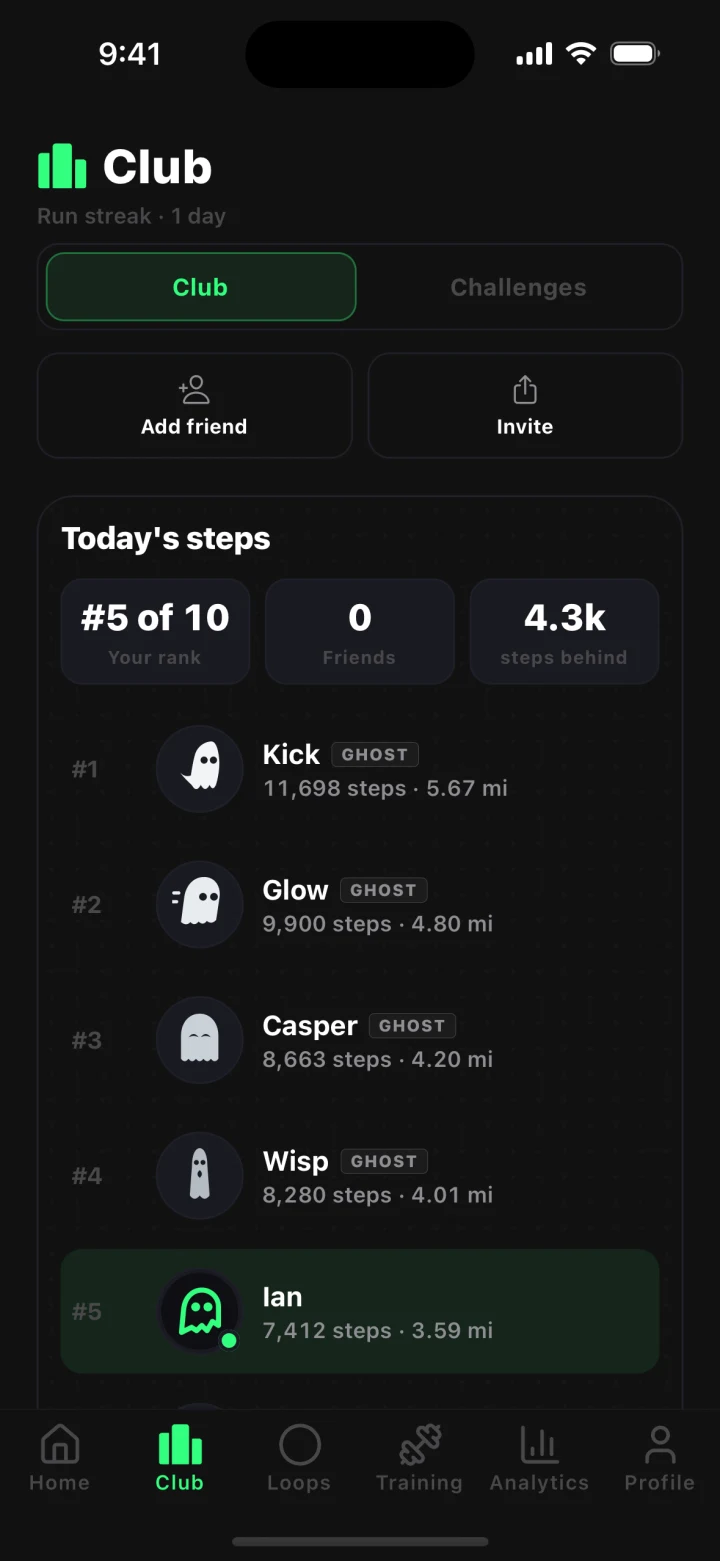
See exactly who you’re chasing.
Ghost Pacers appear by name, character, steps, and distance, with your current place highlighted in GhostLoop green.
Captured from GhostLoop iOS · August 2026Put it in motion
See every Ghost Pacer’s pace, personality, and live place in the field.
Meet all nine pacersEditorial note
How this guide was made
This guide was checked directly against the current GhostLoop pacer constants and the matching website port on August 23, 2026. The pace table uses the shipped proportional scaling and JavaScript rounding. Session anchors, weights, LIVE behavior, local-day calculation, and the 0.92–1.08 factor reflect current code. Personality language is editorial; it is not used to imply a false fixed time-of-day schedule.
About the author
Ian Castillo · Founder, GhostLoop
Ian Castillo is the founder of GhostLoop, a movement app built around racing your past activity, Ghost Pacers, Clubs, and Challenges.
Author profileThis guide is general educational information, not individualized medical advice. Stop activity and seek appropriate professional guidance if symptoms or pain concern you.