9 Step Challenge Ideas for Friends and Clubs
From one-day sprints to month-long consistency games, these formats make a shared leaderboard feel fresh.

In this guide · 7 sections
The best step challenge keeps the field interesting after day one. Raw totals can be fun, but they are only one way to score movement—and they often make a mixed group predictable before the weekend arrives.
These nine formats reward different things: volume, improvement, consistency, shared progress, or route completion. Each one below includes a scoring rule, a useful duration, a tie rule, and the failure mode to prevent.
Choose the format before inviting people. A clear field creates better competition than a clever name attached to rules nobody can repeat.
The short answer
For a mixed-ability group, score percentage of personal goal or consistency days. For a short competitive sprint, use total steps with a clear finish date.
What to remember
- Choose scoring before inviting people.
- Short first challenges create faster feedback.
- Personal-goal scoring can balance different baselines.
- Lightweight stakes preserve the fun.
Choose the behavior before the scoreboard
Start by naming what you want the challenge to reward. Total steps rewards volume. Goal percentage rewards performance relative to a declared target. Consistency rewards returning across several days. Team formats reward coordination and shared progress.
The same group may need a different field next month. A seven-day total is clean for people with similar routines. A percentage or consistency format is often more interesting when one person walks for work and another spends most of the day at a desk.
Some formats require a small amount of manual scoring. That is acceptable when the rules are written before the start. Do not imply that an app automatically calculates a format it does not currently support.
Nine challenge formats at a glance
Swipe table →| Format | Best for | Window | Primary score |
|---|---|---|---|
| Seven-day total | Similar baselines | 7 days | Total steps |
| Weekend sprint | Fast rematch energy | 48 hours | Total steps |
| Lunch-lap week | Workday routine | 5 weekdays | Completed midday walks |
| Goal percentage | Mixed baselines | 7–14 days | % of locked goal |
| Most improved | A group with baseline data | 7 baseline + 7 challenge days | % change |
| Consistency | Habit building | 7–30 days | Goal days |
| Team average | Uneven team sizes | 7–14 days | Average per eligible member |
| Relay target | Cooperative groups | Until complete | Shared total |
| Route takeover | Distance and circuit fans | Custom | Miles completed |
Three formats for pure momentum
These formats are quick to explain and easy to follow. They work best when the group accepts that raw opportunity differs and the stakes remain friendly.
1. Seven-day total
Count every step from a defined Monday start through Sunday finish. Highest total wins. Use the same local timezone for everyone or state whose timezone controls the window before the first day begins.
- — Tie rule: highest single complete day.
- — Best for: a small group with roughly comparable activity patterns.
- — Failure mode: one extremely active job or weekend outing makes the rest of the field irrelevant.
- — Variation: cap the scored total at a generous daily maximum if the group wants to reduce one-day blowouts.
2. Weekend sprint
Run the field for 48 hours, usually Saturday and Sunday. Short duration creates an obvious finish and makes an immediate rematch possible. Announce the window early enough that work, travel, caregiving, and recovery plans are not surprises.
- — Tie rule: most steps on the second day.
- — Best for: a quick burst between longer challenges.
- — Failure mode: treating a scheduled race or hike as secret strategy rather than obvious context.
- — Variation: use a four-hour Club window instead of the entire weekend.
3. Lunch-lap week
Award one point for a purposeful midday walk on each of five workdays. Define the qualifying window and minimum duration before the start—for example, at least ten minutes between 11:00 a.m. and 2:00 p.m. local time.
- — Tie rule: earliest completion of the fifth qualifying walk.
- — Best for: interrupting a seated workday.
- — Failure mode: ranking raw steps and accidentally turning an adherence challenge back into a volume challenge.
- — Variation: teams earn a point only when every active member completes the lap.
Three formats for a mixed field
When normal activity differs widely, score the relationship to each person’s own baseline or declared target. Lock the inputs before the challenge starts so nobody can lower a goal after seeing the field.
4. Goal percentage
Divide the participant’s challenge total by the target for the same window, then multiply by 100. A person with a 56,000-step weekly goal and 50,400 steps scores 90%. Consider capping the scored percentage at 120% so the field rewards reaching beyond goal without making one huge day unbeatable.
- — Tie rule: more days at or above the personal daily goal.
- — Best for: friends with different but honestly chosen targets.
- — Failure mode: changing goals after the challenge begins.
- — Variation: rank daily percentage points rather than one weekly percentage.
5. Most improved
Collect a complete seven-day baseline, then compare it with the seven-day challenge. Calculate percentage change as (challenge average minus baseline average) divided by baseline average, multiplied by 100. Require complete device data in both windows.
- — Tie rule: higher number of days above personal baseline.
- — Best for: a group willing to spend one week measuring before competing.
- — Failure mode: using a sick, vacation, or incomplete week as the baseline.
- — Variation: use minutes walked when step devices are inconsistent.
6. Consistency
Award one point for every day a participant reaches the locked personal goal. A 30,000-step Saturday still earns one point, so returning on an ordinary Tuesday matters just as much.
- — Tie rule: longest uninterrupted streak, then total goal percentage.
- — Best for: seven- to 30-day habit fields.
- — Failure mode: making the goal so low that every day is automatic or so high that one miss ends interest.
- — Variation: award a comeback point for returning immediately after a missed day.
Three formats for teams
Team fields create conversation and allow one person’s off day to become a coordination problem rather than an individual verdict. Make the denominator and inactive-member rule explicit.
7. Team average
Add each eligible member’s steps, then divide by the number of eligible members. This prevents a larger team from winning simply because it has more bodies. Decide whether a person must record at least five complete days to remain eligible.
- — Tie rule: higher lowest-member average.
- — Best for: two or more teams with different sizes.
- — Failure mode: dropping a low scorer after the standings appear.
- — Variation: average each member’s goal percentage instead of steps.
8. Relay target
The entire Club fills one shared target—for example, 250,000 steps. This can be cooperative with no ranking, or two teams can race to the same total. Keep each contribution visible so the shared number still feels connected to people.
- — Tie rule: not needed for one cooperative team; for two teams, first verified finish wins.
- — Best for: groups that want a collective finish line.
- — Failure mode: setting a target that mathematically requires unrealistic daily contributions.
- — Variation: unlock named checkpoints at 25%, 50%, 75%, and 100%.
9. Route takeover
Choose a GhostLoop circuit or mapped route and race by distance. Every eligible walk or run adds miles until the individual or team reaches the course total. State whether one activity can exceed the remaining distance or whether the finish is credited at the exact target.
- — Tie rule: first synced finish; if sync timing is disputed, earliest underlying activity time.
- — Best for: Clubs that respond to maps and visible progress.
- — Failure mode: mixing miles and kilometers in the same scoreboard.
- — Variation: complete a 3.1-mile, 6.2-mile, or 13.1-mile circuit over several days.
Different fields need different rules.
Write rules people can repeat back
Publish one compact rules block before the field opens. Include the metric, eligibility, window, timezone, scoring formula, device policy, tie rule, and when the results become final. Do not change a rule because the first standings are inconvenient.
If a format needs manual calculation, name who calculates it and share the arithmetic. A screenshot is not a complete rulebook; it is evidence attached to a rulebook.
Copy-and-use rules template
Swipe table →| Rule | Question to answer | Example |
|---|---|---|
| Metric | What exactly counts? | Steps recorded by the chosen device |
| Window | When does counting begin and end? | Mon 12:00 a.m.–Sun 11:59 p.m. CT |
| Eligibility | Who is in the denominator? | Joined before start + 5 complete days |
| Scoring | How is rank calculated? | Weekly steps ÷ locked weekly goal |
| Tie | What breaks equal scores? | Most goal days, then shared place |
| Finalization | When can late syncs no longer change rank? | Results lock Monday at noon |
Handle device differences without pretending they vanish
Consumer devices estimate steps using different sensors, algorithms, wear locations, and recognition rules. Research reviews find that accuracy and reliability vary by device and condition. A challenge cannot make those differences disappear.
Use one primary device per person, keep wear or carry behavior consistent, and allow a clearly stated sync window after the finish. Do not manually add mystery steps without a rule the entire group can use. For higher-stakes competition, step counts from unlike consumer devices are a poor basis for pretending the result is exact.
Gamification and social incentives have increased activity in some randomized trials, but the result depends on the people, design, and context. That evidence supports testing social structure; it does not guarantee that every leaderboard motivates every participant.
Keep in mind
Keep the stakes proportional to the measurement. Friendly status, naming rights, or a shared ritual fit estimated consumer data better than expensive prizes.
Finish clearly and make the rematch easy
Announce the final result after the sync window, acknowledge the format—not just the winner—and record one rule to keep or change. A consistency champion and a raw-total champion represent different achievements; name them accurately.
Use a prize that gives the group more identity: the winner names the next challenge, chooses a route, picks the coffee stop, selects the pre-walk playlist, or holds a physical token until the rematch. The reward should strengthen the Club without making movement financially stressful.
Then leave space before the next field. Constant competition can turn a useful spark into background noise. A clean ending makes the next start feel real.
Fast answers
Frequently asked questions
What is the fairest step challenge for different fitness levels?
Goal percentage or consistency is usually more balanced than raw total because each person competes against a locked personal target. The goals must be chosen honestly and locked before the standings open.
How long should a first challenge last?
Seven days is long enough to include workdays and a weekend while remaining easy to understand. A 48-hour sprint is useful for a quick test; a 30-day field needs stronger comeback rules so one missed week does not erase interest.
How should ties work?
Choose the tie rule before the start and match it to the behavior being rewarded. Total challenges can use the highest final day; consistency challenges can use longest streak; percentage fields can use most goal days. Sharing the place is also a valid rule.
Can people use different watches or phones?
They can, but the counts are estimates and may not be directly equivalent. Ask each person to use one primary device consistently, define the sync deadline, and keep prizes lightweight.
Does GhostLoop calculate all nine formats automatically?
No. GhostLoop supports challenge fields using steps, distance, or time across several windows, but some formats in this guide—such as most improved, capped goal percentage, or team average—may require Club rules and manual calculation. The guide labels them as formats, not shipped automatic scoring modes.
What if someone misses a day?
Use a format with a comeback path. Weekly total allows another day to contribute; consistency can award a return point; a team relay lets the group continue. Do not invent a penalty after the miss occurs.
Bottom line
Make the next decision repeatable.
A challenge works when everyone can explain the rules, see a reason to return after an off day, and recognize the group in the prize. Start short, finish clearly, and let the rematch carry the momentum.
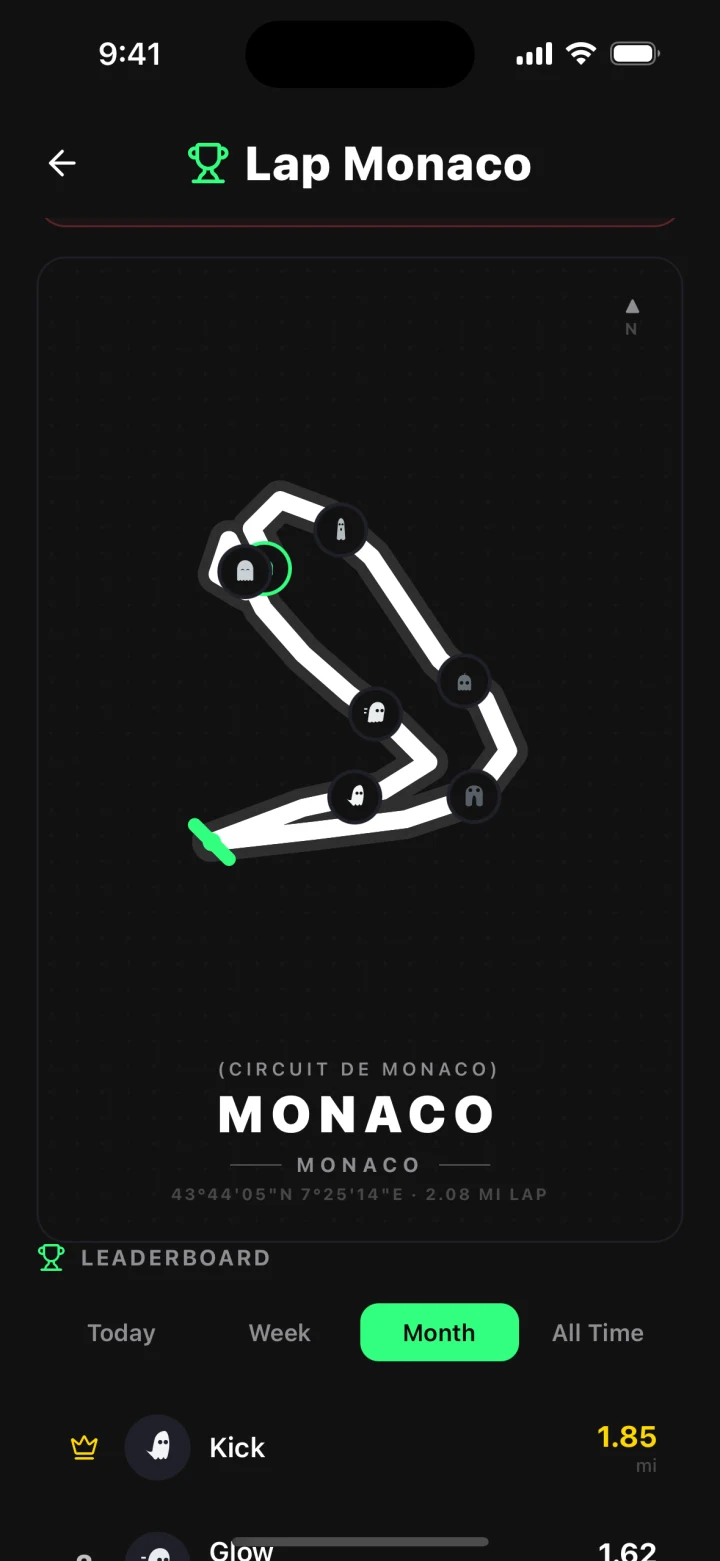
The route is the leaderboard.
A GhostLoop circuit challenge puts the field directly on the course, with the leaderboard and time window beneath it.
Captured from GhostLoop iOS · August 2026Put it in motion
GhostLoop Challenges support steps, distance, and time so the Club can choose the field that fits the week.
See ChallengesEditorial note
How this guide was made
The nine formats and scoring templates are GhostLoop editorial designs. Evidence sources below support narrower claims about social incentives and consumer-device measurement; they do not prove that every format increases activity or that all devices are equivalent. Product references were checked against GhostLoop’s current steps, distance, time, and challenge-window model, and formats that may require manual scoring are identified plainly.
Sources & further reading
About the author
Ian Castillo · Founder, GhostLoop
Ian Castillo is the founder of GhostLoop, a movement app built around racing your past activity, Ghost Pacers, Clubs, and Challenges.
Author profileThis guide is general educational information, not individualized medical advice. Stop activity and seek appropriate professional guidance if symptoms or pain concern you.